
How to Match Belt Color: A Men's Style Guide
Match your belt to your shoes — leather to leather, color to color, finish to finish. That's the rule that covers 80% of situations. The other 20% is where most men go wrong, and that's what this guide is actually for.
Why Matching Your Belt Color Matters
A belt is not an afterthought. It sits at the visual midpoint of the body — the exact place where the eye travels when someone looks at you straight on. Get it wrong and the outfit breaks in half. Not metaphorically. Literally, the upper and lower halves look like they belong to two different men.
The shoe-belt connection is one of those rules that developed for a real reason: it creates a visual anchor between the top and bottom of an outfit, giving the eye a clear through-line. When those two elements mismatch in color or finish — say, a matte black belt with oxblood cap-toes — the disconnect registers even to people who couldn't name a single clothing rule. They just sense something's off.
This matters more in formal contexts than casual ones. At a job interview, a client lunch, or a wedding, your belt choice signals whether you think about what you're wearing. And before anyone dismisses that as shallow — presentation in professional settings correlates directly with how seriously people take what you say in the first three minutes. That's documented, not opinion.
It also matters for women's styling, where the question shifts slightly. How to match belt color for women often centers on whether the belt functions as an accessory or a structural element — cinching a dress versus holding up trousers. Different purpose, different rules, addressed below.
How to Match Belt Color: A Step-by-Step Approach
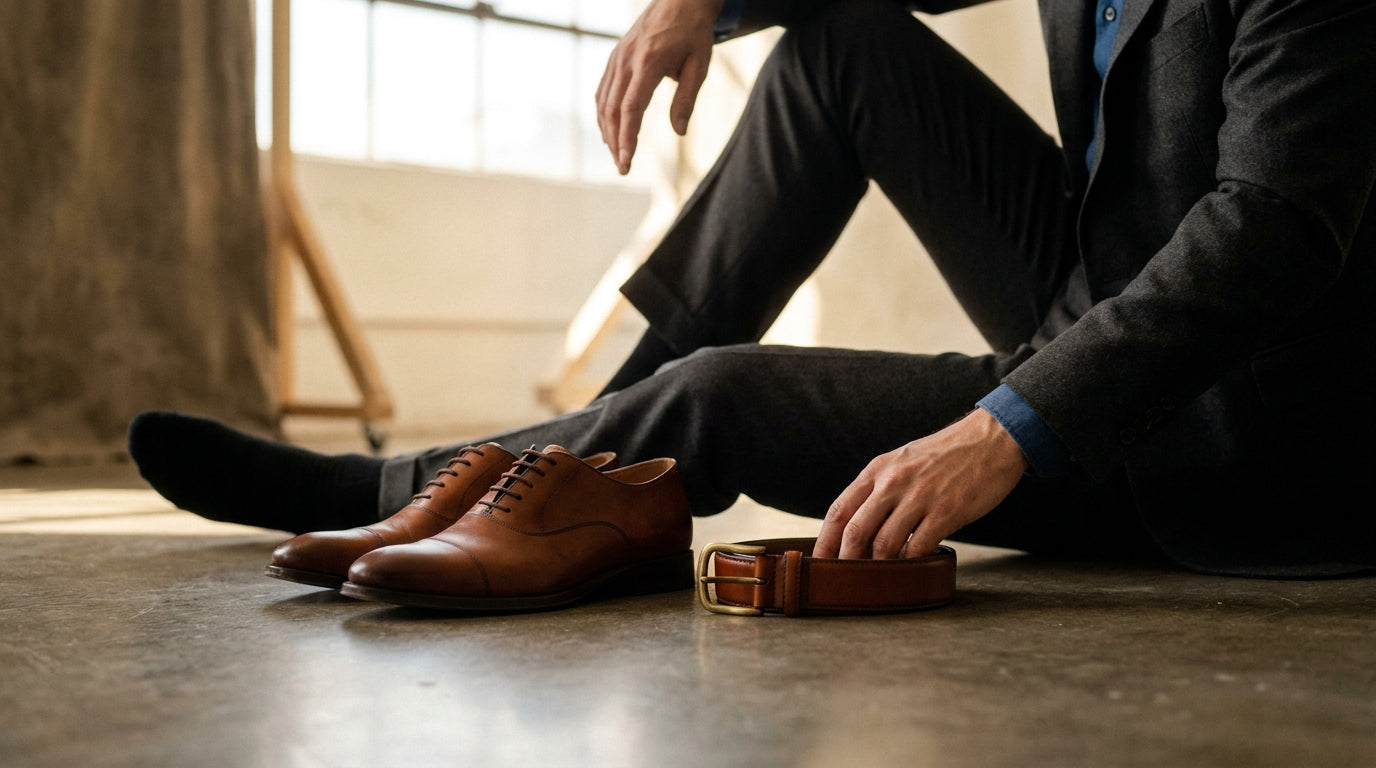
Start with your shoes. Whatever leather color is on your feet is the leather color that should be on your waist. This works because both items share similar construction — vegetable-tanned, chrome-tanned, suede — and the eye reads them as a coordinated system rather than two independent choices.
Step 1: Identify your shoe color precisely. Not "brown" — there are at least eight distinct browns in menswear. Tan, cognac, chestnut, walnut, tobacco, oxblood, chocolate, and dark brown. Each one pairs differently. A cognac belt with dark chocolate shoes looks wrong in a way that's hard to articulate but impossible to miss.
Step 2: Match the finish, not just the color. A matte black leather belt with a high-gloss Oxford is a harder mismatch to forgive than a slight color difference. If your shoes are patent (black-tie context) or high-shine, your belt should be the same. If you're wearing suede derbies — which is a smart casual shoe and deserves more credit — a suede or matte leather belt keeps the tonal logic intact.
Step 3: Consider the hardware. Silver buckles with silver shoe hardware. Gold with gold. This one gets ignored constantly, and it's the difference between a composed outfit and one that looks assembled from whatever was lying around. The VIOSSI Dress Pants in charcoal and slate carry silver-toned belt loops by default — take that as a cue for your buckle choice.
Step 4: Factor in the suit or trouser color. For charcoal, navy, and grey suits, black or very dark brown belts are the only credible options. Mid-brown or tan belts with a dark navy suit look like a mistake, even if each piece is beautiful on its own. For tan, camel, or light grey trousers — a cognac or tobacco belt is the natural fit. Black reads harsh against soft neutral trousers.
Step 5: Dress code determines everything. Business formal means black leather, full stop. Smart casual opens up cognac, tan, and even woven leather. Black tie means you shouldn't be wearing a visible belt at all — braces under a waistcoat, or a cummerbund. For wedding guests wondering how to match belt color for a wedding, the answer is almost always black for formal ceremonies and cognac for garden or outdoor weddings where the dress code softens.

For jeans specifically: how to match belt color for jeans operates on different logic. With raw indigo or dark wash denim, a dark brown or black belt works. With mid-wash jeans and white sneakers — a tan or natural leather belt. With heavily distressed or lighter denim, a woven or fabric belt is actually more coherent than leather, because leather reads too formal against something that casual. The rule is still coordination, just applied to a different context.
On the question of whether belt should match shoes or pants — shoes, always shoes. The trouser color is secondary. A belt bridging shoe and trouser shades tends to look indecisive rather than intentional.
VIOSSI Picks That Make This Easy
The easiest way to solve the belt-matching problem before it starts is to build outfits where the leatherwork is already thought through.
The VIO Suits in midnight navy and charcoal grey come with trousers cut at a mid-rise with a standard belt loop width — meaning a 1.25" to 1.5" belt is the correct width, which covers every dress belt on the market without looking either undersized or like something from a workwear catalog. Pair either colorway with a black pebbled leather belt and black cap-toes and that's the full equation solved for business formal.

For the Men's Blazers worn in smart casual contexts — the single-breasted navy blazer over chinos is a common VIOSSI combination — the belt choice loosens up. Cognac or tan works with stone, khaki, or light grey chinos, and pairs forward with suede or tan leather loafers. This is the context where a woven leather belt in cognac actually outperforms a smooth dress belt; the texture reads as considered rather than borrowed from a suit outfit.
Worth noting: any outfit built around the Men's Double-Breasted Suits collection sidesteps the belt question almost entirely. A double-breasted suit worn properly is always buttoned — the jacket closes over the trouser waistband, making a belt largely invisible and, for many silhouettes, unnecessary. Braces work better here both functionally and visually. If you insist on a belt with a DB suit, make it thin, dark, and completely matte.

The Men's Slim Fit Suits — particularly the lighter grey and oatmeal options — suit a medium brown or cognac belt over black. Black reads heavy against a warm-toned light suit. This is one of the more common errors in wedding season dressing, where men grab whatever dress belt is in their wardrobe without accounting for the fact that their suit is actually a warm sand or stone color, not a cool grey.

Common Mistakes Men Make With Belt Color
Black belt, brown shoes. Still the most committed offense. It's not that black and brown can't coexist in an outfit — they can, in very specific combinations. But the belt and shoe are in direct conversation, and putting them in different color families breaks that conversation entirely. There is no combination of suit, shirt, and pocket square that rescues a black belt worn over a brown Oxford.
The second mistake is ignoring belt width relative to the occasion. A 1.75" or wider belt belongs on jeans or casual trousers. On formal suit trousers, that width is too dominant — it draws the eye downward and reads as workwear. Dress belts run 1" to 1.25". If the belt is visible above the jacket buttons on a single-breasted suit, it's already too wide or the suit doesn't fit properly (likely both).
Mixing leather quality is subtler but equally damaging. Wearing a $400 pair of shoes with a $20 bonded leather belt — where the leather is already starting to crack at the buckle fold — collapses the credibility of the whole outfit. You cannot out-dress a bad belt. The accessories are read as a system, and the weakest link determines the overall impression.
Shiny buckle, matte shoes. Or vice versa. (This one is worth repeating because it's the finishing detail that separates men who understand the logic of an outfit from men who've just assembled pieces that individually seem fine.) Hardware finish alignment is not a minor detail — it's the difference between a polished look and one that's almost polished, which is actually worse than not trying.
For women's outfits, the parallel mistake is treating the belt as a purely functional item when it's actually the most visible accessory on a monochrome or minimal outfit. If someone's wearing an all-black ensemble and the only leather is a wide statement belt — that belt is the outfit's focal point, and choosing it carelessly shows. The question of what color belt goes with everything for women usually has a cleaner answer than most expect: a warm tan or cognac leather belt in a 2" width reads as accessory-forward and pairs with black, white, camel, navy, and most earth tones without conflict. A black belt in the same width is more utilitarian — it disappears into dark outfits rather than adding contrast.
Whether women's belt and shoes have to match: they don't have to, but they should be in the same color family or deliberately contrasting. Accidental non-matching — black shoes, brown belt — reads the same on women as it does on men. Intentional contrast — tan belt with white sneakers over a dark outfit — works because the difference is obvious enough to read as a choice.

For authoritative benchmarks on accessory coordination in formal menswear, the GQ Style desk and Esquire's style section both document how professional stylists approach the accessory-first logic in formal dressing.
Final Tips and Specific Styling Ideas
Navy suit, white dress shirt, black shoes — the belt is black. This is not a conversation. Black Oxford, black belt, no variation required. The only question is the buckle: silver if your watch is silver, gold if your watch is gold.
Charcoal suit with brown suede derbies — which is a strong combination for business casual or smart formal — takes a dark chocolate or walnut belt in matte leather. Not cognac. Not tan. The charcoal suit is cool-toned and the suede derby is a medium-warm brown; you need the belt to sit between those values, not lean fully warm or fully dark.
Tan or camel suit — the kind of suit that reads well for spring weddings and outdoor ceremonies — requires a cognac or medium tan belt with tan leather shoes. A white or cream dress shirt underneath, no tie or a knitted tie in terracotta or burnt sienna. Black shoes with a camel suit is the single most common wedding guest error of the past fifteen years and it still happens at every ceremony.
One genuinely specific piece of advice that requires knowing something about fabric behavior: when wearing linen or cotton-linen blend trousers in warm weather, a smooth leather belt will look inconsistent with the texture of the fabric. A woven leather belt, a canvas-tab belt, or even a braided leather belt in tan or cognac reads as texture-appropriate. The principle here is that accessories should share the same register of formality and tactile weight as the garment they're paired with — linen is relaxed and textured, and smooth dress leather is neither of those things.
For grooms specifically — and this applies directly to how to match belt color for a wedding when you're the one getting married — the answer depends on the suit. A white or ivory suit with black accessories is a specific aesthetic choice that works, but it's aggressive. Most grooms read better in a stone, champagne, or light grey suit with a white dress shirt, and in that case the belt is always tan or cognac to complement the warm fabric tones. The Groom Set at VIOSSI is built around this logic — coordinated pieces so the leatherwork question is answered before you get to the accessories drawer.

Black belts are not default formal. They're correct for black-shoe situations, which is most business formal and evening wear — but the reflex to reach for black as the "safe" choice fails immediately when paired with warm-toned suits, brown shoes, or casual trousers. The genuinely versatile belt — the one that goes with the widest range of outfits for men who want to own fewer accessories and have them all work — is a medium cognac leather dress belt in 1.25", with a brushed silver or antique silver buckle. That single piece covers most smart casual and business casual situations, pairs with tan through dark brown shoes, and works across grey, navy, stone, and camel suit fabrics.
Build your outfit bottom-up: shoes first, then belt, then trousers, then shirt, then jacket. Most men dress top-down and end up with a belt that doesn't fit the equation because it was chosen last, when all the major decisions were already made.