

Double Breasted vs Single Breasted Suit: How to Choose
Two suits, one decision, and most men overthink it. The double breasted suit makes a stronger visual statement and fits fewer occasions. The single breasted suit is more versatile, easier to style, and works across nearly every dress code. If you're buying one suit in 2026, buy single breasted. If you already own two or three, a double breasted is worth serious consideration — and it's more wearable now than it's been in decades, because the current cut has shed the boxy weight that dated earlier versions.
The Core Difference: Double Breasted vs Single Breasted at a Glance
If you only remember one thing, make it this: a single breasted suit has one row of buttons and is worn open or closed; a double breasted suit has two parallel rows, overlaps deep across the front, and is worn buttoned. That single mechanical fact drives everything else. Single breasted is the versatile default — it dresses up, dresses down, splits into a sport coat, and reads correctly at almost any dress code. Double breasted is the deliberate choice — more formal, more structured, and best reserved for occasions where you want the room to notice.
Which is better? Neither, and anyone who tells you otherwise is selling something. They answer different problems. Single breasted wins on flexibility, packing, and everyday wear; it's the right pick for a first suit, a job interview, or a suit that has to carry you from a morning meeting to a Friday dinner. Double breasted wins on presence — it photographs beautifully in low light, frames a broad chest, and signals effort. If your wardrobe is thin, buy single breasted first and add double breasted second. If you're choosing for one specific event, let the formality of that event decide: cocktail, black-tie-optional, or evening leans double breasted; anything smart casual or below leans single. The two aren't rivals so much as tools for different jobs, and most well-dressed men eventually own both.
Shop Men’s Double-Breasted Suits
Still deciding? The full Men’s Double-Breasted Suits range is on our site, in the sizes we stock.
Shop the collection →Free shipping over $299 · Arrives in 2–5 business days · 15-day returns
Visual Comparison: Double Breasted vs Single Breasted Side by Side
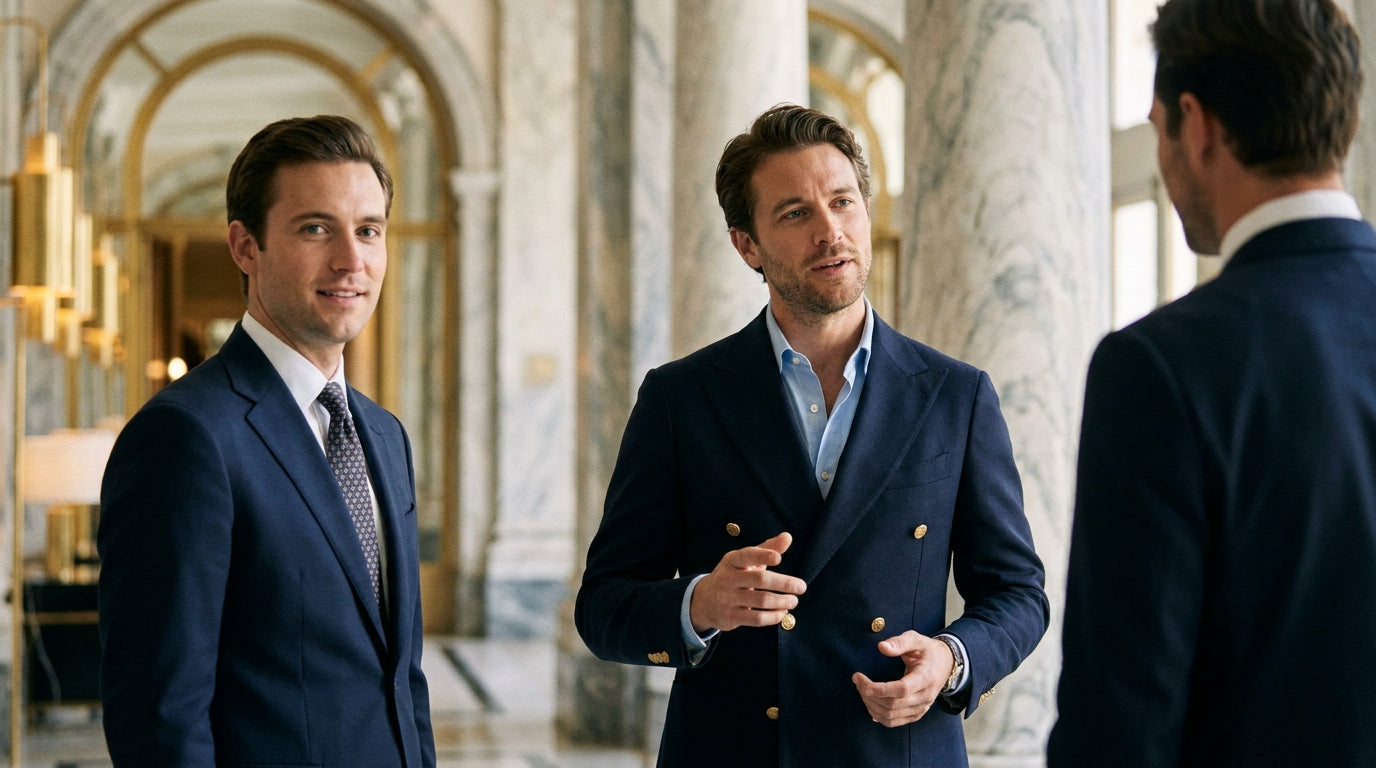
The structural difference is immediate. A single breasted suit jacket closes with one vertical row of buttons — typically two or three — and a relatively narrow front overlap. The lapels sit cleanly, the silhouette reads as neutral. It's the cut that dominated the 20th century and still defines what most men picture when they hear the word "suit."

Shop now →
A double breasted suit jacket overlaps significantly at the front, with two parallel rows of buttons — most commonly a 6x2 configuration (six buttons showing, two to fasten) or a 4x2. The lapels are almost always peak lapels, which angle upward and outward, adding width to the chest and formality to the silhouette. The overall effect is broader, more structured, more deliberate. You wear a double breasted suit. You don't just throw it on.
The other functional difference that gets overlooked: a double breasted jacket should almost never be worn open. It's cut to be buttoned. Unbutton it and the front fabric hangs incorrectly — you get a flapping overlap on one side that looks like you forgot to finish getting dressed. Single breasted jackets, by contrast, can be worn open or closed without consequence. That single detail changes how wearable each style is across a full day.
Lapel shape is also worth examining. Single breasted suits appear with notch lapels most frequently — that small notch where the lapel meets the collar. More formal single breasted suits, particularly evening wear, come with peak lapels. Double breasted suits almost always carry peak lapels; the width of the front panel demands it visually. Shawl lapels show up on tuxedos. (For a full breakdown of lapel shapes, read our guide on peak lapel vs notch lapel — the difference matters more than most men realize.)
When Double Breasted Works Best

Shop now →
Weddings — specifically as a guest, or as a groom who wants to signal that he's thought about this — are the clearest use case. A double breasted suit at a black tie optional or cocktail attire wedding reads as intentional. It says you dressed for the event specifically, not just pulled from rotation. The Camel Double Breasted Suit from VIOSSI works particularly well for afternoon ceremonies with an outdoor element — pair it with a white poplin shirt, no tie, and tan suede loafers. The warmth of the camel against a cream or floral setting reads considered, not costume.
Business formal environments where you're presenting, meeting clients, or otherwise need the room to take you seriously. Not every industry. Law, finance, architecture, high-end real estate — yes. Tech or media — probably not. The double breasted suit carries authority because it takes more effort to wear correctly, and people register that effort subconsciously.
Evening events generally. The double breasted suit has a natural affinity with low light, which is why it translated so well to 1930s Hollywood and why it still photographs well at evening receptions and galas. The structure flatters under artificial lighting in a way that single breasted suits — which rely more on drape than architecture — sometimes don't.
Striped double breasted suits specifically — chalk stripes, pencil stripes, the kind you see on the Beige Striped Double Breasted Suit 2-Piece — work for men who want formality with personality. The stripe adds vertical interest and partially softens the width the double breasted front panel creates. If someone tells you pinstripes went out in 2008, they stopped paying attention in 2008. The stripe has made a strong return in recent years and continues to hold its ground. Pair it with a solid dress shirt — white or pale blue, no pattern — and let the suit do all the talking.
When to Stick with Single Breasted
Most of the time. That's the direct answer and it's worth sitting with before going further.
Single breasted suits dominate job interviews, business casual environments, smart casual events, daytime weddings, and every dress code below black tie. The reason isn't that they're safer — it's that they're genuinely more adaptable. A single breasted blazer can come off the trousers entirely and function as a sport coat over dark jeans. A double breasted jacket does not make that transition cleanly. The formality is built into the garment's structure in a way that resists casual deployment.
Smart casual and business casual dress codes, which now cover the majority of professional environments, specifically reward single breasted cuts. Wearing a buttoned-up double breasted suit to a smart casual office reads as overdressed in a way that draws attention for the wrong reasons. Single breasted, especially in a tailored slim cut rather than a boxy fit, threads that needle between dressed and dressed-up without effort.
Travel is another context where single breasted wins decisively. The jacket folds more efficiently, recovers better from being packed, and — because you can wear it open — remains comfortable across a full day of transit, meetings, and dinner without requiring you to rebutton and adjust constantly. The Men's Slim Fit Suits in the VIOSSI collection are cut for exactly this kind of all-day wearability without sacrificing the structure that makes a suit look like a suit.
The double breasted vs single breasted suit for wedding conversation often defaults to double breasted as the "special occasion" choice. That framing is slightly off. Single breasted works for weddings across every formality level. Double breasted works for a subset of those occasions — higher formality, more controlled environments. If you're unsure of the dress code or venue, single breasted is the correct default, not a compromise.
Double Breasted vs Single Breasted Vest
The same logic scales down to waistcoats. A single breasted vest — one row of buttons, usually five or six — is the standard, and it's what you want under a suit jacket. It sits flat, disappears cleanly under the jacket's button, and works with both single and double breasted suits without any visual conflict. If you're building a three-piece look or wearing a vest with the jacket off, single breasted is almost always the right call.
A double breasted vest is a bolder object. Wider overlap, two columns of buttons, and often a lapel — it reads as a statement piece and is best worn without a jacket, or with a jacket you intend to keep open (which, on a double breasted suit, you won't). It shines at less formal occasions where the vest is the centerpiece: a summer wedding, a rehearsal dinner, a look built around waistcoat and shirtsleeves. Under a buttoned jacket it's overkill and adds bulk. As a rule: single breasted vest for versatility, double breasted vest when the vest is meant to be seen. The VIOSSI vest collection covers both, so you can match the waistcoat to the register of the event rather than forcing one to do everything.
Body Type Guide: Which Flatters You

Shop now →
Taller men with proportional or broad shoulders carry double breasted suits most naturally. The horizontal visual weight created by the wide front overlap, peak lapels, and parallel button rows reads as balanced when there's height to distribute it across. On a man who is 6'1" or above with a structured torso, a 6x2 double breasted suit jacket creates a silhouette that looks correct — chest-forward, shoulder-wide, commanding.
Shorter men can wear double breasted suits, but the execution requires more precision. A 6x2 configuration — six buttons, wider overlap — tends to visually shorten the torso by creating too much horizontal emphasis. A 4x2 cut, which has a narrower overlap and sits higher, is significantly more flattering. Button stance matters enormously here: a higher button point creates the impression of a longer leg line. This is the kind of detail that separates a double breasted suit that looks deliberate from one that looks like it's wearing the man.
Men carrying weight in the midsection often assume double breasted is off-limits. Wrong, but only half-wrong. The double breasted jacket does add visual width to the chest — and because it must remain buttoned, it also covers the midsection more fully than an open single breasted jacket would. The risk is that a poorly fitted double breasted jacket pulls across the chest or creates horizontal tension lines at the button closure. A properly fitted one — where the chest has ease but the waist is suppressed — actually flatters a rounder midsection better than a single breasted jacket worn open, which draws the eye to exactly what you'd prefer it to skip. Fit is the variable that determines everything. Our guide on how a suit should fit covers the specific measurements and checks worth knowing before you buy anything.
Athletic builds — broad shoulders, narrow waist — can wear both cuts well, but double breasted particularly rewards this shape. The peaked lapels frame the chest, the button stance defines the waist, and the overall effect is structured without being stiff. If this is your body type and you've been defaulting to single breasted your entire adult life, try the double breasted. It's one of those situations where the more demanding cut actually makes things easier.
Slim or slight builds benefit most from single breasted suits with some shoulder padding and a chest that doesn't swamp the frame. The horizontal layering of a double breasted front panel can overpower a narrow chest. This isn't a rule that can't be broken — styling and color choice matter — but as a starting point for anyone who isn't sure, single breasted is the lower-risk option on a slighter frame.
One genuinely useful detail that doesn't make it into most guides: the gorge height — where the lapel meets the collar — affects perceived height as much as button stance does. A high gorge on a double breasted jacket pushes the visual center of gravity upward, making the wearer appear taller. Most off-the-rack double breasted suits sit the gorge too low, which creates a slightly dated, slumped appearance even on a good body. When buying ready-to-wear double breasted suits, look for a gorge that sits at or above the shirt collar's second button. Lower than that and you're fighting the silhouette rather than working with it.
The double breasted suit vs three piece conversation is worth addressing briefly. A three-piece single breasted suit — with vest — occupies formality territory adjacent to a double breasted two-piece. The vest adds structure and visual interest to a single breasted silhouette without requiring the commitment of the double breasted front. For men who want to stand out at a formal occasion but aren't ready to commit to the double breasted, a vest layered under a single breasted suit is a considered middle ground. Both are correct. Neither is better in the abstract. It depends entirely on your body type, the occasion, and how much of the room's attention you want.
The question of double breasted vs single breasted wool coat follows similar logic to the suit comparison — the double breasted coat adds formality and visual weight, works best on taller frames, and requires the same commitment to wearing it buttoned. For outerwear specifically, the double breasted overcoat has had a consistent moment in menswear in recent years and the momentum hasn't reversed. The Men's Coats collection at VIOSSI includes options in both configurations for those crossing between suiting and outerwear decisions.
For anyone asking what a double breasted suit is in the most practical terms: it's a suit jacket with a wide overlapping front closure, two columns of buttons, and — almost always — peak lapels. It originated in naval and military dress, migrated to civilian fashion in the early 20th century, peaked in the mid-20th century, returned in a more exaggerated form in later decades, and came back again more recently in a cleaner, more contemporary cut. The current version is narrower in the shoulder, higher in the gorge, and slimmer through the body than its predecessors. What a single breasted suit is, by contrast, requires almost no explanation — one column of buttons, standard overlap, the default template for tailored suiting globally since the mid-20th century.
GQ's style coverage has tracked the double breasted resurgence closely over the past several years — worth reading if you want the runway context behind what you're seeing in stores: GQ Style. Esquire has published useful breakdowns on how the double breasted is being styled across different formality levels: Esquire Style.
Shop Both Styles
The double breasted suits in the VIOSSI collection are cut with a higher gorge and a suppressed waist — deliberately avoiding the boxy 1980s proportions that made the silhouette look heavy. The Men's Double-Breasted Suits range includes the Navy Striped, the Camel, the Dusty Pink, and the Black — four colorways that cover weddings, formal events, business presentations, and evening occasions without duplication. Each is a 2-piece; none requires a vest to look complete.
The Navy Striped Double Breasted Suit in particular is the strongest all-round option in the range for men buying their first double breasted suit. Navy reads as more accessible than charcoal or black, the stripe adds interest without demanding a full fashion commitment, and the versatility of navy means it pairs cleanly with white, pale blue, or even a soft pink dress shirt.
Shop the Look


For single breasted options, the Single Breasted Blazers and the broader VIO Suits collection cover the full range from slim tailored cuts to more relaxed business fits. Free shipping on orders over $299, 2–5 day delivery, and 15-day returns on unused items — so if you're between two cuts or two colors, ordering both to compare at home is a reasonable approach rather than a gamble.
Buy the double breasted suit when you have a specific occasion that demands it and a body type that carries the front panel well. Buy the single breasted suit when you need something that works on Tuesday morning and Friday evening without any adjustments required between them.
| Brand | Price | Fit Options | Fabric | Shipping | Returns | Best For |
|---|---|---|---|---|---|---|
| VIOSSI | $189–$389 | Slim, Regular | Italian wool, linen, cotton blends | Free over $299 · Standard 2–5 days · Duties covered (DDP) | 15-day returns · Unused & original packaging required | Best price-to-quality ratio for Italian-fabric suits |
| SuitSupply | Varies by style | Multiple fit options available | Wool, linen, cashmere blends | Free over a minimum order threshold | Returns accepted within a limited window (conditions apply) | Wide brick-and-mortar presence, good MTM program |
| Indochino | Varies by style | Made-to-measure only | Wool, poly blends | Free shipping, delivery time varies | Alterations policy and refund terms vary — check directly with retailer | Best for MTM budget option, long lead time |
| Bonobos | Varies by style | Slim, Regular, Athletic | Poly-wool blends, stretch fabrics | Free over a minimum order threshold | Returns accepted within a limited window | Best athletic fit, no 3-piece or tuxedo options |
| Jos. A. Bank | Varies by style (frequent promotional sales) | Slim, Regular, Tailored | Poly-wool blends, wool | Free over a minimum order threshold | Returns accepted within a limited window | Constant BOGO sales — actual price often unclear |
Related Guides
Shop Men’s Double-Breasted Suits
That is the shortlist. Every piece above lives in Men’s Double-Breasted Suits, with sizes and prices in one place.
Shop the collection →Free shipping over $299 · Arrives in 2–5 business days · 15-day returns